
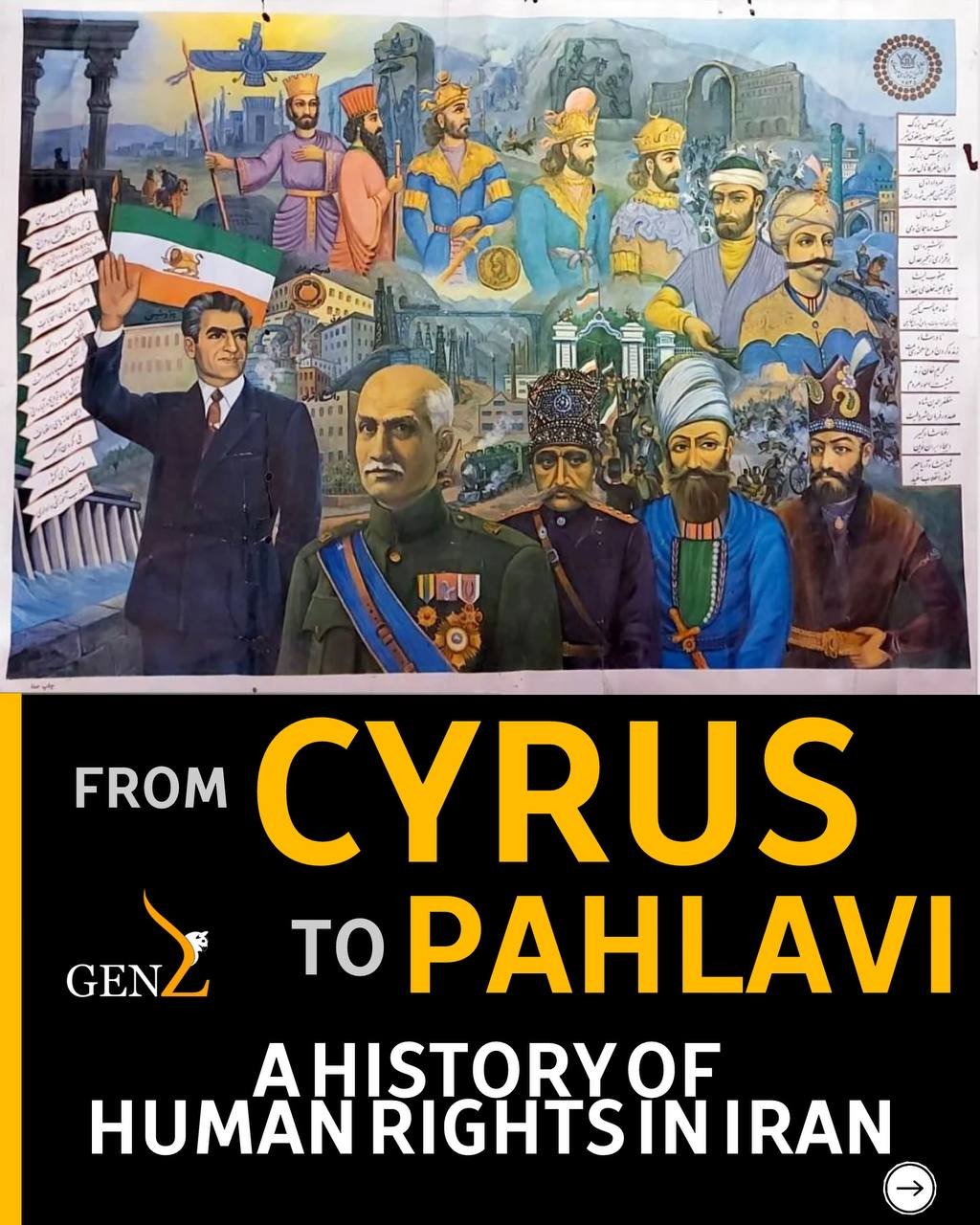
“Now that I put the crown of kingdom of Persia, Babylon, and the nations of the four directions
on the head with the help of God (Ahura Mazda), I announce that I will respect the traditions,customs and religions of the nations of my empire and never let any of my governors and
subordinates look down on or insult them until I am alive. From now on, till God grants me thekingdom favor, I will impose my monarchy on no nation. Each is free to accept it , and if any one
of them rejects it , I never resolve on war to reign. Until I am the king of Persia, Babylon, and thenations of the four directions, I never let anyone oppress any others, and if it occurs , I will take
his or her right back and penalize the oppressor”. These immortal words from the CyrusCylinder, inscribed over 2,500 years ago, symbolize not only a commitment to justice and
diversity but also the enduring ethos of Iranian civilization.Iran’s past is one of unyielding defense of human honor, continuing through thousands of years
of empires and governments. Each period, from the ancient Achaemenid monarchs to modernconstitutional ones, has contributed significantly to the evolution of rights, justice, and statecraft.
It is in acknowledgment of the vast strides toward human rights throughout Iran from pre-Islamicand medieval to contemporary periods, such as Zand, and Pahlavi dynasties.
Pre-Islamic Period: The Pillars of Justice
The Achaemenid Empire, led by Cyrus the Great, had laid the foundation of governance that was
unparalleled in its scope and inclusiveness. The Cyrus Cylinder (539 BCE), which is generallyregarded as the world’s first human rights charter, prioritized freedom of religion, diversity of
cultures, and justice. This text, unearthed at Babylon and now residing in the British Museum,reflects Cyrus’s hope of a world united by respect, not conquest. The empire’s new system of
administration, centered on satrapies (provinces), provided for local control with imperial unity.The subsequent Achaemenid shahanshahs, particularly Darius I, expanded this vision. Darius’s
Behistun inscription not only records his conquests but also emphasizes justice in governance,for he says: “I was not wicked to the weak. I did not tolerate the strong to harm the weak.”
The Parthians replaced the Seleucid Greeks and restored Iranian control, with its usualpreoccupation with decentralization. Their respect for indigenous custom, and their reliance upon
a council of nobles to limit royal power, was the quintessential pluralistic leadership model.As the successors of the Parthians, the Sassanians expanded the ideas of justice and social
responsibility. Based on the Zoroastrian code of ethics, they formulated one of the mostsophisticated systems of law of its time. Under Khosrow Anuhsiravan, the Just king, the
Denkard, a sacred book of the Zoroastrians, which prescribes laws that are based on justice, wasimplemented and this safeguarded the interests of the weak, and fostered social concord. The
qanats (subterranean water conduits) and bridges were ordered to be constructed for the benefitof the towns and villages and therefore the condition of the public good all throughout Iranshahr.
Medieval Period: Survival and Adaptation
Following the Islamic conquest of Iranshahr, Iranian culture and governance significantlyinfluenced the Abbasid Caliphate. Iranian statesmen like Nizam al-Mulk and philosophers like
Abu Nasr al-Farabi enriched the caliphate through their administrative policies and philosophicalinsight. Nizam al-Mulk’s Siyasatnama (The Book of Government) remains a staple of political
theory in its promotion of justice and care for the well-being of those ruled.The Seljuk Empire (1037–1194) borrowed the paradigm of governance adopted by the Abbasids,
mixing Islamic law with Persian tradition. They established madrasas, centers of scholarship,like the Nizamiyya of Baghdad, as model institutions for study and development. Their
commitment to education and to the observance of law of the land resulted in an environment ofstability and intellectual expansion.
While creating destruction at first, the Mongol invasions ultimately resulted in the finalconvergence of Iranian and Mongol administrative models during the Ilkhanate. Persian-based
reforms aimed at taxation equity and public works were implemented by rulers such as GhazanKhan and the later dynasties such as the Timurids.
Modern Period: Renaissance, and Revolution
The Safavids consolidated Iran under Twelver Shi’ism, creating a distinct Iranian identity. Shah
Abbas the Great opened the economy and welcomed Christian and Jewish communities into thetrading networks. While religious minorities experienced fluctuating tolerance, the Safavids
routinized justice through state patronage of clerics and legal scholars.After the fall of Isfahan and subsequently, the Safavids, an army general by the name of Nader
Qoli rose through the ranks and became the Shahanshah of Iran and the head of the new Afshariddynasty. Nader Shah Afshar was a pragmatic and brilliant military strategist who tried to
preserve national unity in the face of sectarian conflict. His attempts at encouraging meritocracyand restoring Persian arts point toward a vision of rule based on stability and preservation of
culture.The Zand Dynasty (1751–1794) is marked by Karim Khan Zand’s rule, which at times is counted
as a golden age of justice and prosperity. Abjuring royal honors, he presented himself as Vakilal-Roaya (Deputy of the People), thus emphasizing that he was a servant of the people.
Throughout his reign, Shiraz developed into a cultural and artistic center, and his policyencouraged economic expansion and established just taxation.
The Qajar dynasty, which held the throne of Iran for over a century, is marked by its weak centralgovernment, inefficient administration, and indifference towards the well-being of the people.
Due to the ruler’s inability and interest in personal wealth, human rights and justice were greatlyundermined during this time, at the expenses of the state.
The founder of the dynasty, Agha Mohammad Khan, founded his reign on unrivaled ferocity.Imposing his will entailed blanket massacres of non-combatants, most renowned of which was
the sacking of Kerman in 1794 and Tbilisi two years later. Thousands were killed and mutilated,creating a legacy of fear and repression that characterized his reign.
During Naser al-Din Shah’s long reign (1848–1896), Iran’s dependence on foreign powersdeepened. British and Russian imperialist incursions aggravated economic disparity and
compromised national sovereignty. The Shah’s extravagance was in sharp contrast to the miseryin which his people lived and served to further destroy faith in the central government.
Modernizing attempts, like the creation of a postal service and railways, were balanced out byrampant corruption and repression. One example of popular discontent was the Tobacco Protest
of 1890, during which Iranians reacted against the Shah’s concession of British monopolies overthe major industries.
The single greatest human rights achievement of the Qajar period was the ConstitutionalRevolution of 1906. The movement, led by leaders such as Sattar Khan, Bagher Khan, Malekol
Motekalemin and Sur-Israfil, aimed to curtail monarchical authority and implement a modernparliamentary code and parliament (Majlis). These reforms were, however, short-lived.
Mohammad Ali Shah (1907–1909) dissolved the Majlis with Russian backing, bombing itsbuildings and killing and imprisoning constitutionalists. Iran, by the end of the dynasty, was
beset by foreign domination, tribal uprisings, and mass poverty.Reza Shah’s rule initiated Iran’s modernization. Having risen from humble beginnings and having
inherited a decrepit state, Reza Shah tried to create a strong, centralized state free of foreigninterference. Although as autocratic as the nature of his rule, the reforms laid the foundations for
modern Iran.Reza Shah created a secular educational system, thus opening the gates of knowledge to Iranians
from across the nation. The opening of University of Tehran in 1934 was an indication of hisenthusiasm for learning and development of his countrymen. Women’s roles in society started
changing during Reza Shah’s reign. Unveiling, as contentious as it was, was one of the moreambitious efforts to bring women into public life.
The Shah resurrected Iran’s pre-Islamic past, thus forging a national identity rooted in theglorious histories of the Achaemenid and Sassanid empires. His centralizing policies and
repression of political opposition were roundly criticized, however. Despite these flaws, hisvision of a modern, independent Iran is very much a part of his legacy.
The former Shah, Mohammad Reza Shah Pahlavi ascended to power in an unstable Iran in themidst of World War II and devoted most of his reign to attempting to reconcile modernization
and political stability.The White Revolution, initiated in 1963, was the Shah’s reform campaign for modernizing the
economy and society of Iran. The initiative entailed land redistribution, the expansion ofwomen’s suffrage, and the development of education and healthcare. Although these reforms
enfranchised millions, they also alienated feudal landlords, clerics, and radical leftists.The Shah’s regime was criticized for employing SAVAK, the secret police, but his opposition
movements—most prominently the MEK, or Mujahideen-e-Khalq, Fadayi Khalq, and radicalclerics—quite routinely acted far worse. Not only did they employ terrorism, but they targeted
civilians and infrastructure specifically. Their acts of violence essentially nullified any claim todevotion to genuine human rights.
The Shah’s foes were, and are, Iranian democracy’s worst enemies. Radical leftists tried toimpose Marxist dogma, while the clerical opposition, led by Ruhollah Khomeini, wished to
establish a theocratic dictatorship. Both despised individual freedoms and democratic principles.In spite of being confronted with mounting foreign pressure and domestic uprisings, the Shah’s
record, including having one of the most stable economies in the area and transforming basicindustries, is for itself. His downfall in 1979 was a tragedy for Iran and for the region.
The 1979 Islamic Revolution ended the Pahlavi dynasty and brought a time filled withunprecedented human rights abuses under the Islamic Republic.
The new government legalized discrimination against political dissidents, religious minorities,and women. The imposition of Islamic law by the state provided the government with a rationale
for public stonings and executions, along with other punishments.Baha’is, Christians, Jews, and Sunnis are all systematically persecuted. They have had their
properties confiscated, and their rights to work and to be educated are grossly limited.Protest movements, including the 2019 protests and the “Women, Life, Freedom” protests
between 2022 and 2023, were brutally suppressed. Thousands of protesters were arrested,tortured, or murdered. Corruption and misrule by the regime have driven Iran into a state of
economic crisis, with unemployment and inflation reaching record levels.Ever since the Islamic Republic, the concepts of justice and human dignity that once defined Iran
have been replaced with a regime committed above all to its own survival rather than the welfareof its citizens.
Iran’s human rights record has been that of resistance, some improvement, and retrenchment. Iranhas tried to be a shining example of civilization and justice in the Middle East and the world,
from the tolerant empire of Cyrus the Great, revered by all as the father of human rights, to thePahlavi liberal reforms. But there have been many counterforces—be they feudal monarchs
opposed to change, revolutionary radicals anxious to impose their ideologies, or theocraticelements determined to monopolize power—who have all moved to degrade the high and noble
tradition which Iran has labored to uphold in its extensive and storied past.Iranians continue their unrelenting pursuit of freedom and dignity to this day, driven by the rich
and fertile past, and the unparalleled prosperity that defined the rule of those leaders who weretruly committed to the well-being and happiness of their people. In doing so, Iranians undertake
a reassertion and rediscovery of their devotion to a better and brighter future by paying tributedeeply to this cultural heritage and looking intentionally into their origins.
References
Books
● Abrahamian, E. (1982). Iran between two revolutions. Princeton University Press.● Amanat, A. (2017). Iran: A modern history. Yale University Press.
● Axworthy, M. (2008). Empire of the mind: A history of Iran. Basic Books.● Daryaee, T. (2012). Sasanian Persia: The rise and fall of an empire. I.B. Tauris.
● Frye, R. N. (1984). The history of ancient Iran. C.H. Beck.● Katouzian, H. (2009). The Persians: Ancient, medieval and modern Iran. Yale University
Press.● Keddie, N. R. (2006). Modern Iran: Roots and results of revolution. Yale University
Press.● Mottahedeh, R. P. (1980). Loyalty and leadership in an early Islamic society. Princeton
University Press.● Nizam al-Mulk. (2002). The book of government or rules for kings: Siyasatnama (H.
Darke, Trans.). Yale University Press.● Perry, J. R. (2005). Karim Khan Zand: A history of Iran, 1747–1779. University of
Chicago Press.● Wiesehöfer, J. (2001). Ancient Persia: From 550 BC to 650 AD. I.B. Tauris.
Articles and Journals● Fisher, W. B. (Ed.). (1968). The Cambridge history of Iran: Volume 7, From Nadir Shah
to the Islamic Republic. Cambridge University Press.Web Sources
● British Museum. (n.d.). The Cyrus Cylinder. Retrieved fromhttps://www.britishmuseum.org
● Iran Chamber Society. (n.d.). History of Iran: The White Revolution. Retrieved fromhttp://www.iranchamber.com
● Livius.org. (n.d.). The Behistun Inscription: Translations and analysis. Retrieved fromhttps://www.livius.org
● United Nations Human Rights Office. (n.d.). Iran human rights violations. Retrievedfrom https://www.ohchr.org