
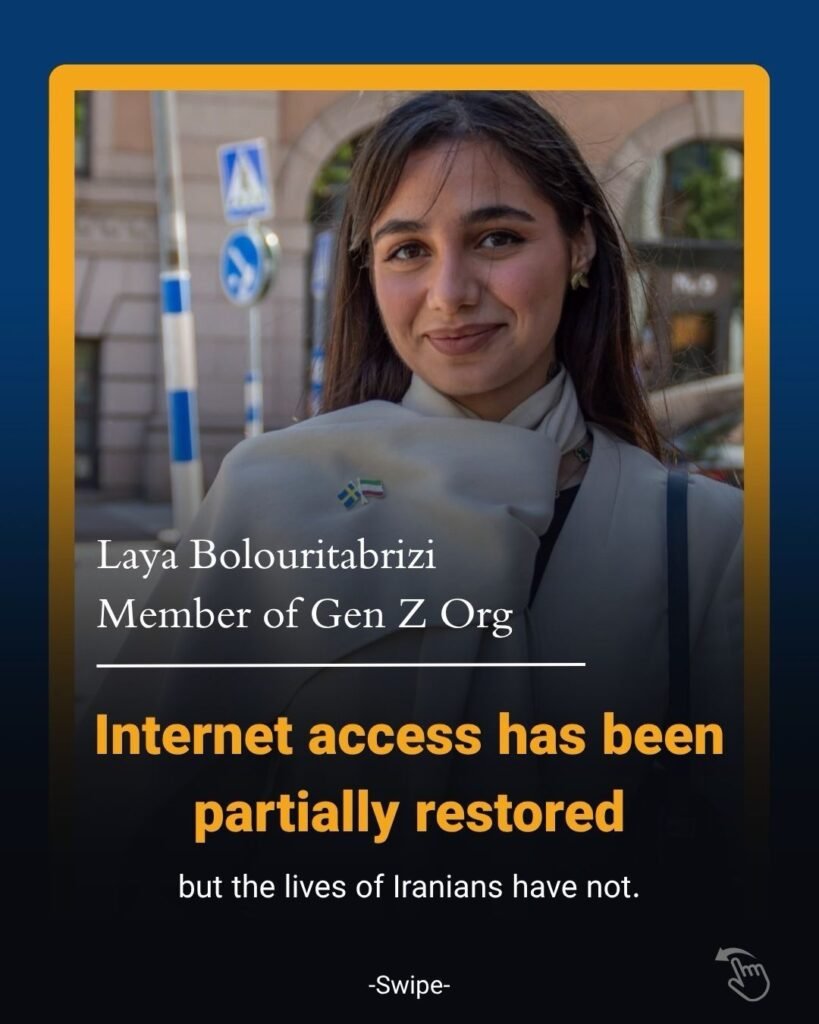
Internet access has been partially restored — but the lives of Iranians have not.
What was never meant to be stolen cannot be returned as a favor. Basic freedoms are not gifts from a regime; they are rights that belong to the people.
Do not be fooled. No dictatorship willingly gives people a free voice when doing so threatens the illusion it works so hard to maintain. Instead, the Islamic Republic carefully controls the narrative, amplifying approved voices while censoring independent reporting and silencing dissent.
For millions of Iranians, the Islamic Republic is not merely a regime governing Iran, but an occupying entity ruling over it — a system that places revolutionary ideology above the Iranian nation while suppressing its identity, aspirations, and sovereignty through fear, coercion, and violence.
The struggle in Iran is not between competing political factions. It is between a nation seeking to reclaim its future and a system determined to maintain its grip on power at any cost.
By allowing limited contact between families and restoring only parts of the internet, the regime seeks to relieve international pressure and create the appearance of normalcy. In reality, these small concessions make it easier for the regime to continue and gradually intensify its repression.
While state media attempted to portray a picture of a free and happy Iran on the beaches of Kish Island, a mother visiting her parents’ grave was reportedly shot five times by a Basij member in front of her son for allegedly violating the mandatory hijab law.
The regime’s greatest advantage is that many of its actions seem too extreme to be real. The brutality is so severe that people instinctively search for a more comfortable explanation. The Islamic Republic depends on that disbelief. The horror becomes easier to dismiss than to confront.
Meanwhile, the world looks away. It is easier to rely on limited information than to trust a nation whose people continue risking their lives in order to tell the truth. As attention fades, the regime expands its surveillance capabilities and strengthens censorship systems, including technology acquired from authoritarian partners abroad.
Executions continue. Fear grows in the streets. Entertainment and personal freedoms face increasing restrictions. Violence remains the regime’s immediate response to disobedience. Piece by piece, a system of control is tightened around an entire nation.
Nothing in Iran will be normal as long as the Islamic Republic remains in power. The threat it poses — both to Iranians and to regional and international stability — will continue to grow as long as it is ignored.
The Islamic Republic continues to buy time. Time to strengthen its grip. Time to inflict greater damage. And every act of silence, indifference, or willful blindness gives the regime exactly what it wants.