
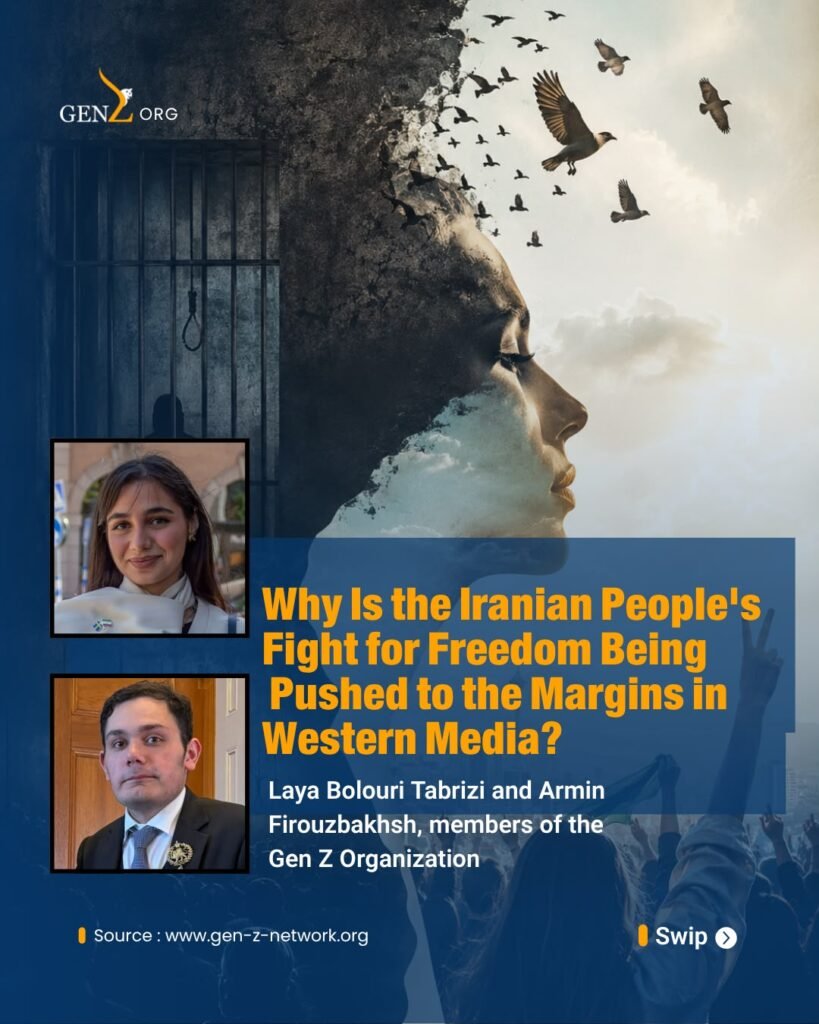
Why is Iran’s fight for freedom being silenced in Western media?
European media are sharply critical of the US and Israel – but silent about the Islamic regime’s systematic massacres of its own people. Selective journalism risks making us complicit toward the oppression of 90 million Iranians fighting for their freedom, write Laya Bolouritabrizi and Armin Firouzbakhsh.
After his visits to Stockholm and Berlin, Crown Prince Reza Pahlavi sharply criticized the European media and their reporting on Iran. He said that journalists seemed more focused on criticizing the United States and Israel for eliminating Iran’s supreme leader than on criticizing the Islamic Republic’s massacre of the Iranian people.
He points out that during these press conferences, which lasted several hours and brought together over a hundred journalists, he was not asked a single question about the 40,000 Iranians who fell victim to the brutality of the Islamic regime. Not a single question was directed at the many executions or the political prisoners who are still at risk of execution. Instead, he found that the focus was more on criticism of his father, despite his attempt to tell the stories of the people behind these innocent lives.
The Crown Prince’s message exposes one of the greatest contradictions of our time: How can a regime that, for decades, has relied on systematic oppression through torture—torture, political imprisonment, rape, kidnappings, organ trafficking, and the inhumane execution of tens of thousands of innocent Iranians since 1979—still receive such limited scrutiny in Europe’s public discourse?
While the world continues to build narratives on the innocent blood of Iran’s children, executions and death sentences remain tools used by the Islamic regime to intimidate and silence the Iranian people. People are sentenced to death simply for demanding a life free from oppression, yet these cases go astonishingly unnoticed by European media.
Around 2,200 Iranians were executed by the Islamic regime in 2025. Reaching such numbers requires the execution of several people every single day. Halfway into 2026, rising figures are being reported, indicating an escalation of violence by the Islamic regime, which has already executed nearly 800 Iranian political prisoners.
When the focus and actions of the Western world result in the Islamic regime’s oppression of its own people receiving less attention and less reaction, an uncomfortable question must be asked:
Since when did journalism accept selectively choosing which victims deserve to be brought to light?
The Crown Prince’s criticism also carries a historical dimension. During the 1979 Islamic Revolution, Ayatollah Khomeini, who was then residing in France, received a major platform through international media to spread his criticism of the Shah to a global audience.
Today, when the Crown Prince is interviewed, the focus often shifts toward requiring him to answer for his father’s historical rule, as well as the actions of the United States and Israel — rather than on his vision for Iran’s future.
The Islamic regime has long controlled information through censorship and propaganda. Today, it is becoming increasingly clear that the battle over narratives is not only taking place inside Iran’s borders, but that the outside world’s perception of Iran is also shaped by political interests, ideological perspectives, and selective reporting.
Is the problem that Iranians are suffering — or that their suffering does not fit the narrative that some seek to establish?
Does Iran’s opposition, driven by the loss of 40,000 lives and the hopes of a nation of 90 million people united in the pursuit of freedom, need to adopt a feminist, left-wing, or Islamist identity in order to be viewed as legitimate or sympathetic in Swedish media?
If millions of opposition supporters stand behind a vision that places humanity at the heart of Iran’s future, why are their voices not represented with the same level of attention?
Crown Prince Reza Pahlavi and his work are often examined through the voices of critics invited by Swedish media — individuals who neither place emphasis on the will of the Iranian people nor present a concrete solution.
In reality, there is an established team of people with deep knowledge of the Crown Prince’s work and the Iran Prosperity Project, ready to answer questions, address criticism, and explain the vision behind a potential transitional government.
Why is the perspective so often limited to critics of the opposition, while those who actively work alongside the movement remain absent?
Is part of the explanation related to the Crown Prince’s relationship with Israel?
The consequences of such an approach are unforgivable when media outlets treat a genuine struggle — one that has cost the Iranian people countless lives in their pursuit of justice — as if it were merely a façade: something appearing principled on the outside but hollow within.
The world is not controlled by hiding the truth, but by directing people’s attention toward the parts of the truth that serve those in power.
Truth loses its value when it is constantly adjusted to fit a preferred narrative. A society can only defend freedom and human rights when it is willing to confront the uncomfortable parts of reality — even when those realities are closer to our own world than we would like to admit.
For Crown Prince Reza Pahlavi — a voice that has consistently spoken for the freedom of the Iranian people throughout these 47 years — and for the people of Iran, this is not about political games. It is about life, freedom, and the future.